Why traceable meat is the recipe for competitivity
In today's fast-paced and rapidly evolving food market, transparency is the key to competitiveness and strategic advantage. Read how Atria has built its pork export chain around full traceability that sets the Finnish company apart from the rest and helps your business thrive.
Meat traceability ensures food safety, fosters consumer trust, and facilitates compliance with complex regulatory requirements. Traceability from farm to fork enables the quick identification and removal of contaminated products, thereby reducing health risks and protecting brand reputation. Additionally, an increasing number of consumers are now prioritizing ethical sourcing, animal welfare, and sustainability. Traceability provides the transparency needed to meet these expectations.
"Our meat traceability system, from piglet to packaging, is unique on the global scale and ensures complete chain-of-custody control and gives our partners and their customers confidence in the origin, health, and quality of every product", explains Niina Immonen, Development Director at Atria.
The basis of the farm-based traceability chain
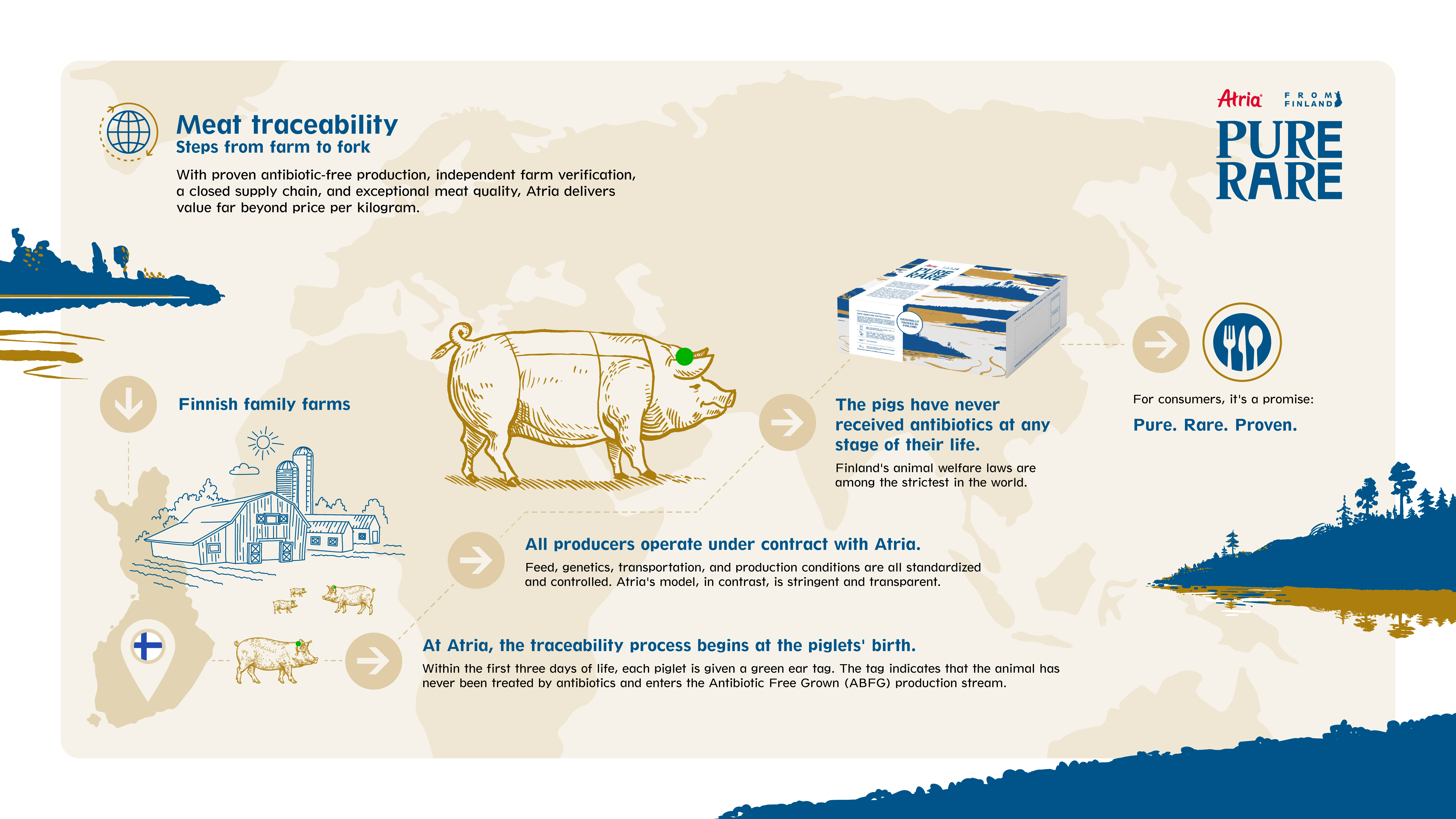
At Atria, the traceability process begins at the piglets' birth. Within the first three days of life, each piglet is given a green ear tag. The tag indicates that the animal has never received antibiotics and enters the Antibiotic Free Grown (ABFG) production stream.
"If the piglet falls ill at any point, it is treated appropriately for its wellbeing, the tag is removed, and the animal is removed from the ABFG stream. Also, pigs that remain healthy are marked. The procedure is maintained through processing and packaging," explains Katja Virmalainen, Quality Manager at Atria.
Also, the traceability information is not limited to internal records.
"On retail packaging, we can include the name of the farm where the pig was raised, along with the carbon footprint of the product. This allows consumers to scan a QR code on the package and access verified information about the product's origin and sustainability profile", Immonen adds.
Why meat traceability matters to export customers
For many international customers, particularly outside of the EU, "antibiotic-free" production is either loosely defined or inconsistently applied. Atria's model, in contrast, is stringent and transparent. The pigs have never received antibiotics at any stage of their life—not as piglets, not during weaning, and not during finishing. This holistic approach provides added assurance for both regulators and consumers.
This level of integrity is made possible by Atria's fully closed and vertically integrated production chain. All producers operate under contract with Atria. Feed, genetics, transportation, and production conditions are all standardized and controlled. No new investment or production change occurs without approval.
"Thanks to the procedure, over 90% of our total pig farms qualify under ABFG protocols", notes Immonen.
In addition to being genuinely antibiotic-free, Atria pork is also free of hormones and salmonella. Finland applies a zero-tolerance policy toward salmonella across all serotypes, and any positive case is handled in cooperation with authorities to ensure that affected animals do not enter the food chain.
"This level of control and food safety is unique and highly valued in export destinations," Virmalainen emphasizes.
Beyond compliance: together for animal health and welfare
All Atria farms are part of the Sikava national livestock quality system. The third-party audited and certified database logs detailed records about animal health, medication use, and veterinary visits. Each farm is required to maintain a proactive health care plan, and more than 5,000 veterinary visits occur annually across our network. These visits include both production and animal-based observations to ensure compliance and welfare.
"Moreover, Finland's animal welfare laws are among the strictest in the world. For example, Finland and Sweden are the only EU countries to comply fully with the ban on pigtail docking. Atria pigs are kept in conditions that naturally discourage aggressive behavior, with 25% more space than their counterparts in Central Europe. These standards are not just for compliance—they're built into our value promise", says Immonen.
Feeding the sustainable future
Atria pigs are raised on a diet that reflects both sustainability and local sourcing. Ninety-three percent of the feed is based on locally produced barley, without the use of soya or animal-based raw materials. Protein feed is manufactured as a byproduct of barley processing at Anora, supporting circular food economy models and significantly reducing deforestation-related impacts from global soy production.
"Thanks to these practices, the carbon footprint of Atria's farm-traced pork is just 3.2 kg CO₂e per kilogram of carcass weight—50% lower than the international average. This is a significant differentiator for environmentally conscious markets and a direct outcome of our controlled supply chain", rejoices Immonen.
Above all, choosing Atria pork means choosing more than just meat. It is a commitment to food safety, sustainability, and complete transparency. With proven antibiotic-free production, independent farm verification, a closed supply chain, and exceptional meat quality, Atria delivers value far beyond price per kilogram. For distributors, retailers, and consumers alike, it's a promise: Pure. Rare. Proven.